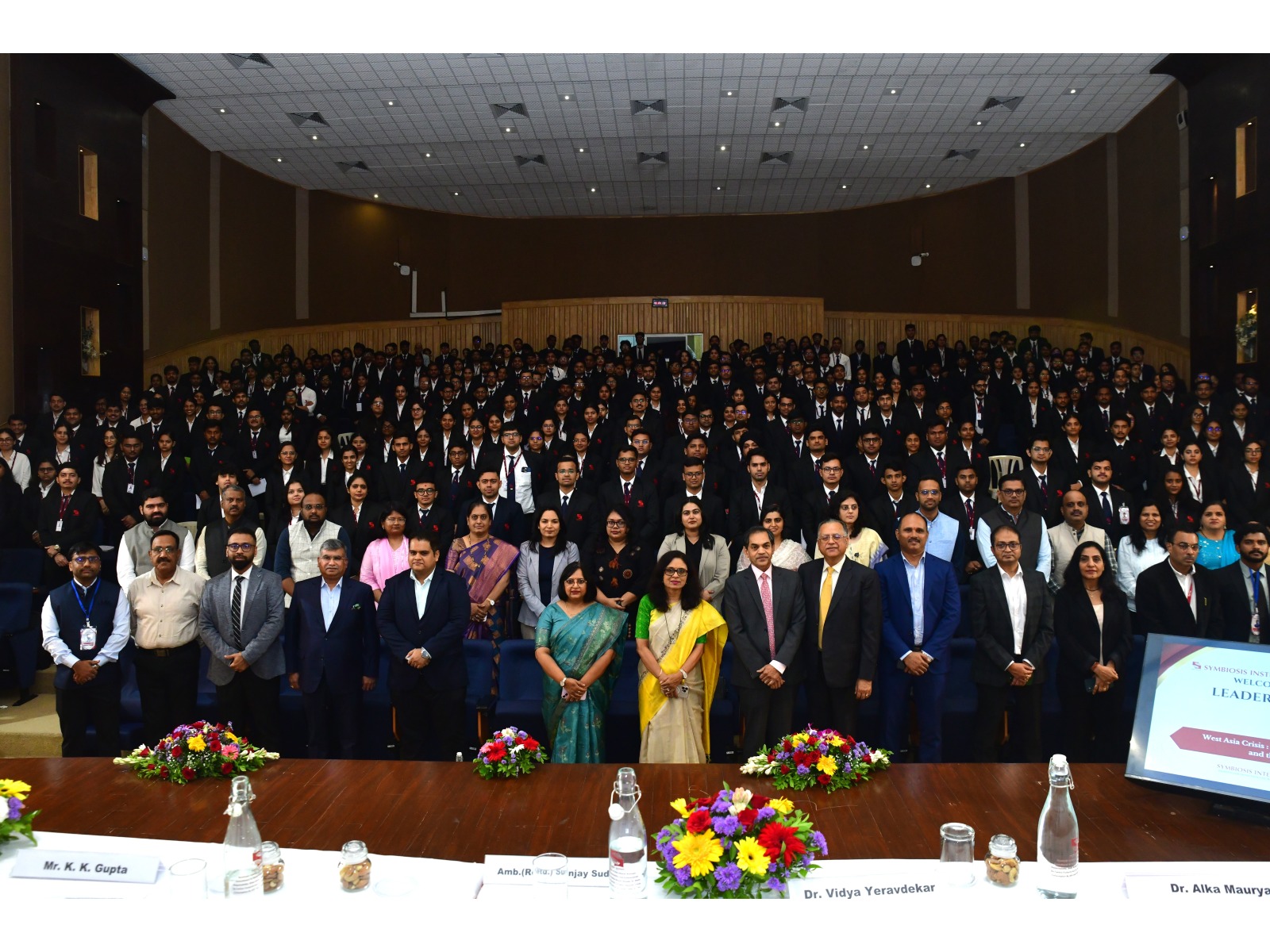
SIIB Pune Hosts Leadership Series 2026 on West Asia Crisis and Its Impact on Global Trade and Business
Sep 15, 2026
SMPL
Pune (Maharashtra) [India], September 15: Symbiosis Institute of International Business (SIIB), Pune, hosted the SIIB Leadership Series 2026 on Friday, August 21, 2026, under the guidance of Prof. (Dr.) Alka Maurya, Director, SIIB. The flagship event brought together eminent industry leaders, scholars, and management students to deliberate on the theme “West Asia Crisis: Reshaping Global Trade, Energy, and the Future of Business.” The event was attended by over 300 students from the MBA (International Business, Agri-Business, and Energy & Environment) batches of 2025-27 and 2026-28.
The event commenced with an opening address by Dr Vidya Yeravdekar, Principal Director, Symbiosis and Chancellor, Symbiosis International (Deemed University), who addressed the gathering and set the tone for the discussions ahead. Mr. Sunjay Sudhir, Former Indian Ambassador to the UAE, subsequently addressed the gathering, highlighting the changing geopolitical landscape and its implications for global markets and businesses. He emphasised the need for organisations to move beyond operational efficiency towards strategic resilience by planning for uncertainty, strengthening energy security, and developing alternative supply options. The address was followed by the formal felicitation of the distinguished guests and a Vote of Thanks delivered by Dr. Ganesh Valiachi, Faculty In-charge, Leadership Series 2026.
The first panel discussion, titled “Delivering Through Disruption: The Economic Fallout of the West Asia Crisis,” was moderated by Prof. (Dr.) Alka Maurya, Director, SIIB. Mr. K. K. Gupta, Managing Director & CEO, Global Smart Comtrade Pte. Ltd., Dubai, shared first-hand experiences of navigating disruptions in international trade, including challenges arising from geopolitical uncertainty, shipment and deal delays, and sovereign payment risks. He highlighted the importance of assessing risks early, adapting business decisions to changing circumstances, and maintaining resilience while operating in volatile markets. Mr. Kaushalya Gaonkar, Managing Director, Knorr-Bremse CVS India Pvt. Ltd., discussed the cascading impact of geopolitical disruptions on automotive supply chains and the importance of operational discipline and supplier resilience. Mr. Vasant Menon, Assistant Vice President, JM Baxi Ports and Logistics, examined maritime freight disruptions, Suez Canal and Red Sea challenges, and the importance of multimodal freight reallocation. Mr. Kartikeyan Iyer, Head of Sales and Handling (West), Lufthansa Cargo, addressed restricted airspace, rising Aviation Turbine Fuel costs, and constrained cargo capacity, highlighting the need for flexible contracts and a “Just-in-Case” approach to international trade.
The second panel, “West Asia Crisis and Implications for Businesses in India,” was moderated by Dr. Ajit Ranade, Senior Fellow, Pune International Centre. Dr. Ranade highlighted how geopolitics is increasingly influencing corporate balance sheets, with disruptions at critical chokepoints such as the Strait of Hormuz, Bab el-Mandeb, and the Suez Canal affecting freight, fuel, insurance, and overall business costs. Mr. Rahul Bharadwaj, Supply Chain Leader, Global Capability Centre, The Lubrizol Corporation, discussed the transition from globalisation towards “globalisation”, domestic value addition, and the role of Atmanirbhar Bharat in strengthening supply-chain resilience. Mr Birendra Pandey, Head of Commercialisation at Enfinity Global India, highlighted renewable energy, utility-scale solar power, Battery Energy Storage Systems (BESS), and critical mineral supply chains as strategic priorities for India's energy security. The discussions provided students with practical insights into geopolitical risk, maritime and aviation disruptions, supply-chain resilience, energy security, and the growing importance of strategic self-reliance. The Leadership Series reaffirmed SIIB's commitment to equipping future-ready management professionals with the knowledge and strategic perspective required to navigate an increasingly volatile global business environment.
All the speakers were of the view that “resilience is no longer merely a response to disruption but a strategic capability for navigating an uncertain future”. The discussions highlighted how shifts in geopolitics extend far beyond national borders, influencing boardrooms, markets, supply chains, and critical business decisions. The session encouraged the audience to look beyond disruptions and develop the agility, adaptability, and strategic mindset needed to navigate them. As aptly captured in the key takeaway, “You cannot always control the disruption, but you can build the agility to navigate it.” The event thus served as a valuable platform for students to connect global developments with real-world business challenges and prepare themselves for a dynamic and interconnected business environment.
The seamless execution of the Leadership Series was supported by the dedicated Batch 2026-28 student organising team, whose efforts in event coordination, hospitality, and logistics contributed significantly to the event's success. The event concluded with a Vote of Thanks delivered by Dr. Anudeep Arora and Dr. Jestin Johny, Faculty In-charge, Leadership Series 2026, who expressed gratitude to the esteemed speakers, guests, organisers, and participants for making the event a success.
(ADVERTORIAL DISCLAIMER: The above press release has been provided by SMPL. ANI will not be responsible in any way for the content of the same.)